Instruments
Quick links
Active documents
- La Jolla Agreement
- Agreement on the International Dolphin Conservation Program (Amended oct 2017)
- AIDCP Amendments (Amended oct 2017)
- AIDCP Rules of Procedures
- AIDCP Rules of confidentiality
- Criteria for cooperating non-parties
- IATTC-WCPFC Memorandum of Cooperation (MOC) on the cross-endorsement of WCPFC and IATTC and approved observers when observing on the high seas of the convention areas of both organizations (Signed August 2011)
Dolphin safe
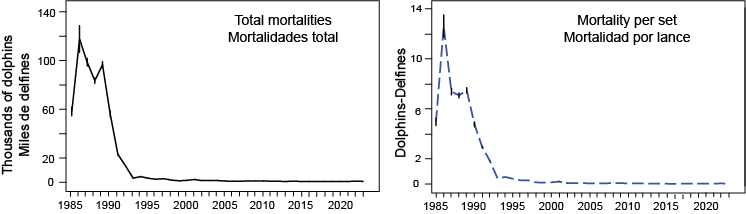
The first objective of the Agreement on the International Dolphin Conservation Program (AIDCP) is to reduce incidental dolphin mortalities in the purse-seine fishery in the eastern Pacific Ocean to levels approaching zero. This Agreement and its predecessor, the 1992 La Jolla Agreement, have been spectacularly successful in meeting this objective, as shown by the reduction in mortality of dolphins incidental to fishing. (see Table)
During 2024 96% of all sets made on tuna associated with dolphins were accomplished with no mortality or serious injury to the dolphins. Furthermore, the total mortality of dolphins in the fishery has been reduced from about 132,000 in 1986 to 859 in 2024.
- Further reading
- Francis, Robert C., Frank T. Awbrey, Clifford A. Goudey, Martin A. Hall, Dennis M. King, Harold Medina, Kenneth S. Norris, Michael K. Orbach, Roger Payne, and Ellen Pikitch.1992. Dolphins and the Tuna Industry. National Academy Press, Washington, D.C.: xii, 176 pp.
- Gosliner, Michael L. 1999. The tuna-dolphin controversy. In Twiss, John R., Jr., and Randall R. Reeves (editors), Conservation and Management of Marine Mammals. Smithsonian Institution Press, Washington: 120-155.
- Hall, Martín A. 1998. An ecological view of the tuna-dolphin problem: impacts and trade-offs. Rev. Fish Biol. Fish., 8: 1-34.
- Joseph, James. 1994. The tuna-dolphin controversy in the eastern Pacific Ocean: biological, economic, and political impacts. Ocean. Develop. Inter. Law, 25 (1): 1-30.
- Scott, Michael. 1996. The tuna-dolphin controversy. Whalewatcher, 30 (1): 16-30.
Previous procedures & guidelines (for reference)
- Joint WG on Fishing by Non-Parties, Terms of reference
- COVID 19 Pandemic Exemption Procedure for the Operation of On-Board Observers
- Memorandum 0412-420 31 December 2022
- Memorandum 0269-420 21 June 2022
- Memorandum 0105-420 28 March 2022
- Memorandum 0564-420 16 December 2021
- Memorandum 0352-420 20 September 2021
- Memorandum 0101-420 08 April 2021
- Memorandum 0847-420 21 December 2020
- Memorandum 0480-420 21 October 2020
- Memorandum 0349-420 24 July 2020
- Memorandum 0227-420 13 May 2020
- Memorandum 0150-420 30 March 2020